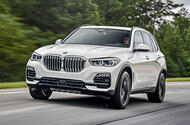
A comprehensive rework of the X5 has produced a more capable, convenient, refined and classy SUV that’s a more satisfying drive, despite an occasionally crashy ride BMW has sold over 2.2 million X5s since its first SUV appeared in 1998, the version we sample here the latest, fourth-generation iteration of this highly successful model.Almost everything is new. According to project leader Johann Kisstler, a man with 40 years-worth of experience developing BMWs, there were three broad development goals for this latest X5. First, to offer a genuinely sporting drive, as implied by the BMW badge, and to combine this with real comfort and considerable off-road capability.Second was refinement, and not merely aural. ‘The X5 is one of our most expensive cars, and the most in demand,’ explains Kisstler. ‘It needs to create a strong premium impression through the quality of materials and the standards of finish.’ Put another way, the X5 is a BMW calling card, and it needs to leave a good impression. Third on the hit-list was ‘a high-level of driver assistance, but without making a computer on wheels.’These aims have been targeted within the envelope of a noticeably bigger X5, which has put on girth (up 66mm), length (36mm) and height (19mm). This is not about physically distancing the X5 from its X model siblings but about safety and packaging, says Kisstler. The desire to install three child seats across the bank bench and pass the stringent pole crash test demanded more shoulder width, while the 42mm wheelbase stretch added cabin space.A higher aluminium content – all the body’s hinged panels, the front wings and some core structure – allows the new X5 to maintain much the same weight on an equivalent equipment basis, says Kisstler, adding that the X5’s high production volumes preclude the use of carbonfibre, as employed on the 7 Series.Even the carry-over engines have been substantially reworked to meet the demands both of the new Worldwide harmonised Light vehicle Test Procedure, and the Real Driving Emissions. At launch BMW will offer three engines, starting with the 261bhp 3.0 litre 30d. It’s a straight six rather than the previous four because that’s how they like ‘em in America, and it’s expected to take 65 percent of UK sales.For slightly more money comes the 335bhp 3.0 40i, also a six, while the current top-of-the-range powertrain is a 395bhp diesel, the M50d’s sextet of cylinders boosted by no less than four turbochargers. A V8 50i, and a plug-in hybrid, follow within a year. Although these engines are broadly carry-over, powertrain boss Reinhardt Brandstatter says that ensuring they perform well in the WLTP and RDE tests, deliver improved real-world fuel consumption and good driveability was ‘challenging’.The 40i’s cylinder head has been redesigned for 350 bar injection pressures and now features a particulate filter, intelligent cooling and a friction-reducing single row timing chain. It’s now almost six kg lighter, too. The 30d has also been reworked, if less extensively, its exhaustings processed by a suite of catalysts and AdBlue treatment.All feed power to a wider ratio’d, eight-speed Steptronic gearbox of improved shift refinement. It drives all four wheels, the rear axle usually receiving most torque, while hill descent control is standard. The xDrive system includes an electronic rear differential lock with the M Sport package that’s expected to take 80 percent of sales, a new optional off-road package adding a sump guard, centre diff lock and programming for sand, gravel, rock and snow conditions.Also standard, unusually for BMW, is height adjustable air suspension, making for a decently complete package even in standard xLine form.


Comments
Post a Comment